
Cash, Credit, and the Bookkeeping Gap: What We're Learning About Small Firms' Financial Lives

About a third of the small firms in our study have three months of expenses in the bank. About one in ten could last only a week. Most have access to credit, and when they ask for more, they usually get it. Yet two-thirds say they'll rely mainly on savings, not credit, to fund their next investment. Why? And why can the same set of bookkeeping records lead one lender to offer a loan and another to turn it down?
Earlier this month, the Financial Access Initiative presented preliminary findings from Small Firm Diaries USA at the Opportunity Finance Network’s Small Business Finance Forum in Austin, Texas, an annual gathering of CDFIs and other lenders deploying capital to small firms across the country. In a session on the financial lives of small employer firms, FAI’s Managing Director Tim Ogden was joined by Brad McConnell (CEO, Allies for Community Business), and Esther Bailey (Professor of Practice, University of Houston) to walk through what the data is showing so far, and what it means for the lenders and CDFIs that are working to serve these firms well.
A glimpse into the firms’ financial lives
An important caveat: firms with lower-quality or no bookkeeping records aren't yet included in this data, since collection and cleaning are ongoing; their inclusion later is likely to shift these numbers.
Below are some key insights on how the firms in our sample are managing their financial lives:
Most owners are preparing their bookkeeping records (profit and loss, balance sheets, cash flow statements) themselves, using software like Quickbooks, Wave, or others.
About a third of firms report that they have at least 3 months of cash on hand, while about one-tenth say they could continue operating for only a week if they received no further revenue.
For about half of the sample, average monthly revenue exceeds average monthly expenses by roughly 25%.

The shifting credit problem: less about access, more about the right fit
Among the firms for which this data is available at the time of writing (approximately half of our sample), around 80% have some form of credit on their books, including loans, lines of credit, credit cards, or mortgages. About a third of firms had applied for new external credit in the past twelve months, with point-of-sale lenders (e.g. Square) and banks or credit unions the most common sources of funding.
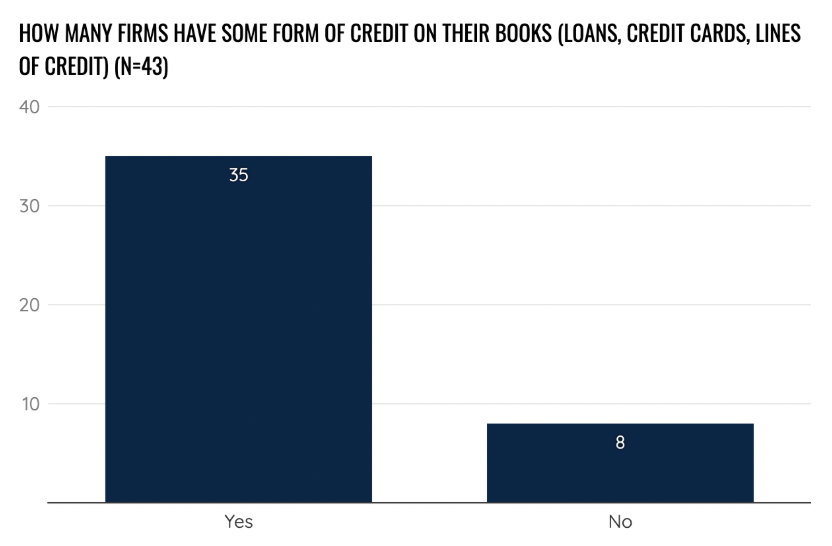
Covering operating expenses or funding expansion were the most frequently cited reasons for new credit. Of those who applied, almost all received the full amount they requested.
Yet credit is often not the primary lever firms use to fund expansion or cover expenses: while four-fifths expect to make at least one new investment in the next twelve months, two-thirds say they’ll rely mainly on personal or business savings.

Credit is not strictly unavailable, then, but what’s available doesn’t always meet needs on cost, risk, or the toll it takes on an owner’s personal credit. We’re still gathering data on why.
The bookkeeping gap
SFD USA is examining the gap between the bookkeeping records firm owners keep to run their business (profit and loss, balance sheets, cash flow statements) and the documents most regulated lenders require for a credit application.
As part of SFD USA, we ran a discrete survey with a small group of CDFI lenders using anonymized bookkeeping records from a subset of firms in the study. We found substantial variation in how different CDFIs evaluated the same firm. After reviewing these firms’ financial records, some said they would offer a loan product while others said they’d offer none at all. Similarly, some firms were considered good candidates for technical assistance, but not by all lenders.

Results from the CDFI survey
Nearly all of the CDFIs requested additional documents before any decision, including bank statements, repayment history for existing loans, and tax returns, and would weigh non-financial factors like the purpose of credit sought, the owner’s plan for improving cash flow, and the state of their personal finances and available collateral. How those factors are weighted and what conclusions they lead to is far from uniform (more findings on this forthcoming).
Esther Bailey, Professor of Practice at the University of Houston, offered a practitioner's view of why that gap exists. Esther and her colleagues run the SURE program, working closely with small firm owners to build the administrative and financial management skills the job requires. They often start from basic budgeting and bookkeeping, since many owners arrive with little to no experience in financial matters.
Without a foundation in bookkeeping fundamentals, many owners don’t have the records lenders want, or don’t have them in the form that lenders need to assess risk (and to separate real businesses from fraudulent applications). Even owners with the necessary documentation vary widely in its completeness, which is part of why the same firm can be assessed so differently by different lenders. For an owner, that variation can mean the difference of thousands of dollars in credit or access to technical assistance that helps a firm grow.

Results from the CDFI survey - CDFIs asked to evaluate the quality of
bookkeeping records compared to the clients they usually serve
Ten years of change in underwriting: building trust through mission
Brad McConnell offered a lender’s view on how the underwriting landscape has shifted over the last decade. Where lenders once relied on paper documents, credit memos, and approval committee review, with credit scores playing a central role, Allies for Community Business (A4CB) in Chicago has streamlined how it assesses applications.
A4CB now accesses bank accounts and credit reports electronically, running underwriting algorithms that ignore credit scores in favor of cash flow and debt repayment behavior, and returns a decision to an applicant almost instantly. From there, a Zoom call serves a dual purpose: building a relationship with the borrower and checking for fraud. A formal offer and contract follow shortly after.
Brad also spoke about how A4CB’s approach reflects its mission: wherever possible, A4CB says “yes” to owners first, using that as a starting point to build trust with borrowers, rather than requiring an established relationship before extending credit. That’s riskier than many lenders are comfortable with, and it requires funders willing to take that risk. But it lets A4CB disburse loans faster, and almost half of the firms in our study who had applied for a loan from a bank in the last 12 months cite speed of decision-making as one of the primary reasons they choose a lender.
Looking ahead
Data collection is ongoing, and as we gather and clean more data, we expect these preliminary findings to shift. The granular, longitudinal nature of the diaries methodology means we'll be able to track how credit quality, bookkeeping practices, investment behavior, and lender evaluation play out over time, and to identify where practices, policies, and financial products could better serve firm owners.


Comments